Oral-B vs. Sonicare for Kids: Electric Toothbrush Guide
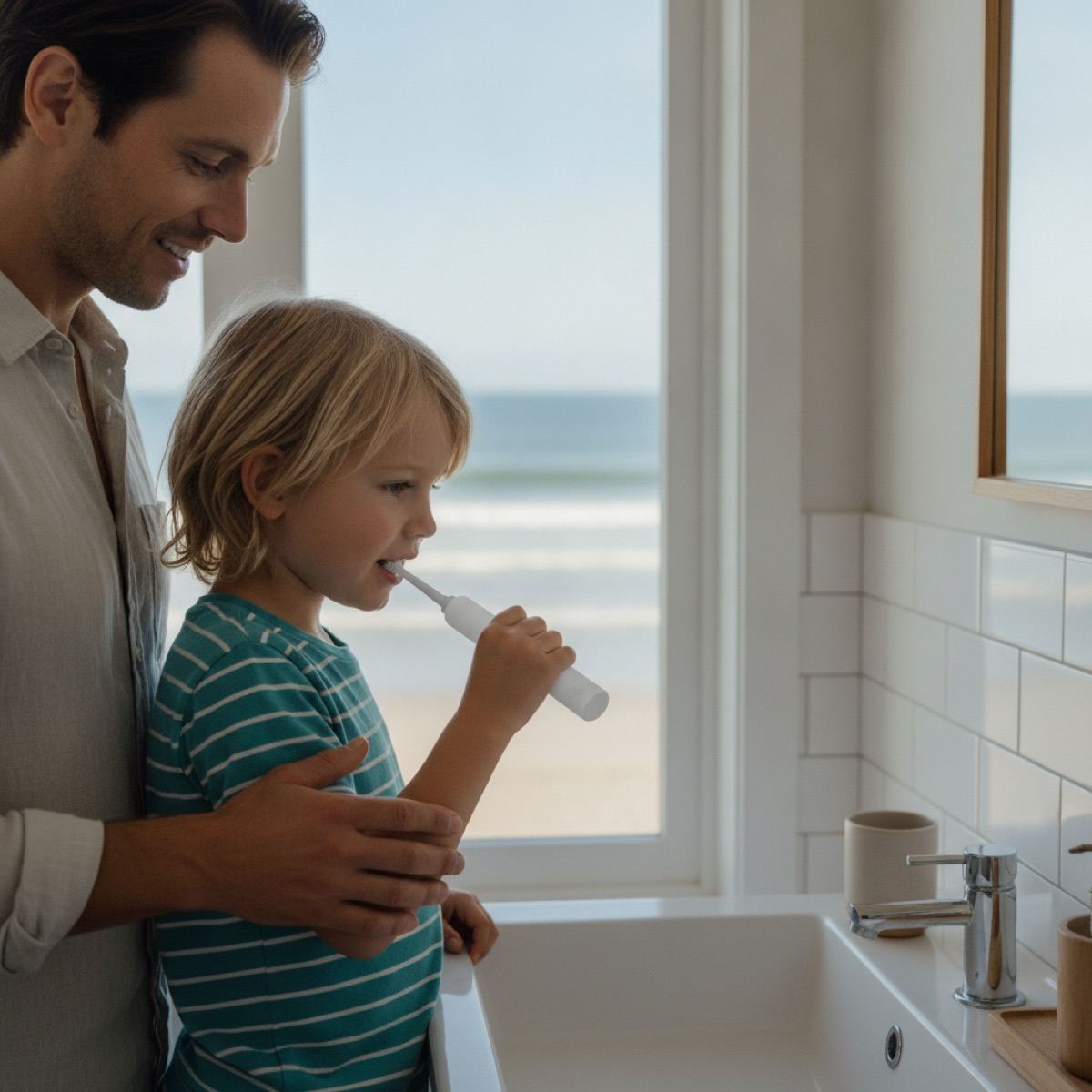
Any electric toothbrush with soft bristles and a timer is a good choice for a child. Oral-B and Sonicare both work. This guide explains the differences.
Parents ask us about toothbrushes at almost every visit. The aisle is crowded, the prices vary a lot, and it is hard to know what matters. Here is what we tell families in the office.
The short answer
• Any good electric brush can work well. The motor sets the pace. Your child still guides it.
• Oral-B and Sonicare are both solid. Choose the one your child will use.
• Look for soft bristles, a small head and a two-minute timer. These matter more than the brand.
• A water flosser is a useful extra. It does not replace brushing, but it is much better than skipping cleaning.
What an electric toothbrush does
Plaque is a thin, sticky film of bacteria. It builds back on teeth every day. Brushing works by wiping it off.
An electric brush does the wiping motion for you. It also keeps a steady pace, which helps children who rush. In studies, powered brushes remove somewhat more plaque than manual brushes on average. The motor does not do the whole job, though. You still need to guide the brush to every tooth.
If you want the broader comparison, see our guide to electric vs. manual toothbrushes.
Oral-B and Sonicare: two different motions
Oral-B uses the round head. Sonicare uses the oval head.
• Oral-B uses a small round head that rotates back and forth. You hold it on one tooth at a time. Its approach has a lot of research behind it.
• Sonicare uses an oval head that vibrates side to side very quickly. You guide it along the teeth and gumline, much like a regular brush.
Both clean well when used correctly. Some reviews lean slightly toward round oscillating heads, but the gap is small. How well your child brushes matters more than which motion they use.
Many children can say which one they prefer after trying both. A round head is easy to place tooth by tooth. An oval head feels closer to what they already know. Each brand has a kids' line: see Oral-B's kids' section and Sonicare for Kids. Most kids' models are labeled for ages 3 and up.
The vibration, and getting used to it
Many children dislike the buzz at first. It can tickle, sound loud inside the head, or trigger a gag. Some children are especially sensitive to texture and sound. This is common and usually passes.
A gradual start helps:
• Let your child hold the brush while it is off.
• Turn it on and feel the buzz on a fingertip.
• Then try one tooth for a few seconds.
• Use the lowest setting at first and build up over a couple of weeks.
• Choose a brush with a ramp-up feature if you can. Some start gently and increase power gradually. Sonicare's Easy-Start does this over the first couple of weeks.
Younger children can use an electric brush if they tolerate it. An adult should still do or check the brushing until about age 7 or 8.
Soft bristles still matter
Power and hard bristles do not mix. Scrubbing hard wears away enamel and can push gums back. Choose soft or extra-soft bristles and a head sized for a child's mouth. Our bristle hardness guide goes deeper.
Replace the head every three months, or sooner if the bristles spread out. A worn head cleans less well.
Cleaning along the gumline
Plaque collects along the gumline first. The gold dots show where.
Plaque collects first where the tooth meets the gum. When it stays there, gums turn red and puffy and may bleed. This early stage is gingivitis. It is reversible with better cleaning.
With an electric brush:
• Angle the bristles toward the gumline.
• Rest the brush there and move slowly from tooth to tooth.
• Spend about two seconds on each tooth.
• Do not press hard. If your brush has a pressure sensor, follow it.
More on gums in our guide to preventing and treating gingivitis.
Plaque, acid and white spots
Early decalcification looks like a dull, chalky patch. Good cleaning and fluoride can often reverse it.
Plaque bacteria feed on sugar and make acid. The acid pulls minerals out of the enamel. This is called decalcification, and it first appears as dull white spots. If it continues, a spot can become a cavity.
White spots are common around braces, where plaque hides behind the brackets. An electric brush can help during orthodontic treatment. See our guide to toothbrushes and floss for braces.
Acidic drinks add to the problem. Soda, juice, sports drinks and frequent sipping all soften enamel for a short time. Two habits help:
• Rinse with water after an acidic drink, and wait about 30 minutes before brushing.
• Use the toothpaste you and your dentist have chosen, in the right amount for your child's age. Fluoride toothpaste helps enamel rebuild. If your family prefers a non-fluoride approach, we will plan around that with you.
Early white spots can often reverse with better cleaning. Later ones can sometimes be treated without a drill. Ask us about resin infiltration.
Costco, Amazon and generic brushes
Costco and similar stores. A good place to buy name-brand brushes. They often sell multipacks with extra heads.
Amazon. Fine, with some care. Listings include the real brand sold by the brand or an authorized seller, unbranded generic brushes, and replacement heads of uncertain origin. Look-alike and counterfeit heads exist. Buy heads from the brand or a seller you trust.
Generic electric brushes. They are not automatically bad. A $20 brush your child uses twice a day beats an expensive one in a drawer. Here is what you may give up:
• Consistent quality. Bristle ends may be rough, or the head may fit loosely.
• Gentle motion. Some cheaper motors are harsh or too strong for a small mouth.
• Features. A timer, pressure sensor or low-power mode may be missing.
• Battery and charger quality. We would be most careful here, since the brush sits in a child's bathroom.
• Replacement heads. They can be hard to find later.
A simple test: soft bristles, a built-in timer, easy-to-find replacement heads, and, where possible, the ADA Seal of Acceptance.
Water flossers: a useful extra
Best: brush twice a day, then add the flosser. A water flosser helps. It does not replace brushing.
A water flosser, such as a Waterpik, sends a thin stream of water between teeth and along the gums. It flushes out food and loosens plaque. For children with braces it is often easier than floss.
It does not scrub, though. Plaque is sticky and needs bristles to wipe it off tooth surfaces. So a water flosser does not replace brushing. It reaches places a brush cannot.
We will also say this plainly: a water flosser is far better than nothing. If the choice is a water flosser or skipping cleaning between teeth, use the water flosser.
For children, an adult should help. Most are ready around age 6. Use the lowest pressure, have your child lean over the sink, and brush afterward. More in our guides to water flossing and water flossing vs. traditional flossing. The ADA also has an overview of water flossers and of choosing a toothbrush.
Buying checklist
• Soft or extra-soft bristles and a small head
• Built-in two-minute timer
• A gentle or low-power setting, ideally with a ramp-up
• ADA Seal of Acceptance, if possible
• Replacement heads that are easy to find
• A real brand, from the brand or an authorized seller
• A feel your child can accept
A pediatric dentist near you
Good home care works best alongside regular visits. We have five offices across San Diego County, so there is usually one close to home or school.
• Carmel Valley: Carmel Valley, Del Mar, Torrey Hills, 4S Ranch, Del Sur, Rancho Santa Fe and Sorrento Valley.
• San Diego (Kearny Mesa): Clairemont Mesa and Kearny Mesa.
• Santee: Santee, El Cajon, La Mesa, Lakeside, Alpine and Spring Valley.
• Eastlake (Chula Vista): Eastlake, Chula Vista, Otay Ranch, Bonita and Otay Mesa.
• South Bay: National City, Chula Vista, San Ysidro, Imperial Beach and Otay Mesa West.
Families tell us they value how convenient it is. You can book online, text any office, and reach us for same-day emergencies. We handle most insurance, including Medi-Cal and Smile California. Your child's dentist and orthodontist work as one team in the same place, so you are not driving between offices.
Part of the community
We want to be a neighborhood practice in more than name. Our doctors volunteer, from the UCSD pre-dental free clinic to teaching future pediatric dentists at Rady Children's. Several have joined dental mission trips abroad. Several live in the neighborhoods they serve, and we have cared for San Diego families for decades. Some of today's parents were once our patients. You can read more about us and about the Coastal Compass™, the way our team coordinates care at each stage of growth.
Bring the toothbrush
If you are not sure your child's brush is working, bring it to their next visit. We will check their technique, look for plaque and white spots, and show them where they are missing. Questions about Oral-B, Sonicare, a Costco two-pack or a water flosser are welcome.
Book a visit at any of our five San Diego offices. New patients are always welcome.
Explore Our Services
Related Articles